What Is Account Abstraction?
When you set up a crypto wallet for the first time, you get a 12-word seed phrase. You write it down and store it somewhere safe, but can still end up losing it. One simple mistake that makes your funds completely unrecoverable.
For the past decade, this has been the standard onboarding experience for millions of potential users. The question is: How can account abstraction solve this problem?
What Is Account Abstraction?
Account abstraction is a model where wallets can operate as programmable smart contracts rather than static key pairs. In the traditional Ethereum model, the protocol enforces a fixed set of rules on how accounts authorize transactions using one private key. Account abstraction removes that fixed rule set. Each wallet defines its own authorization logic: who can sign, under what conditions, and how fees get paid.
The Problem of Traditional Ethereum Accounts
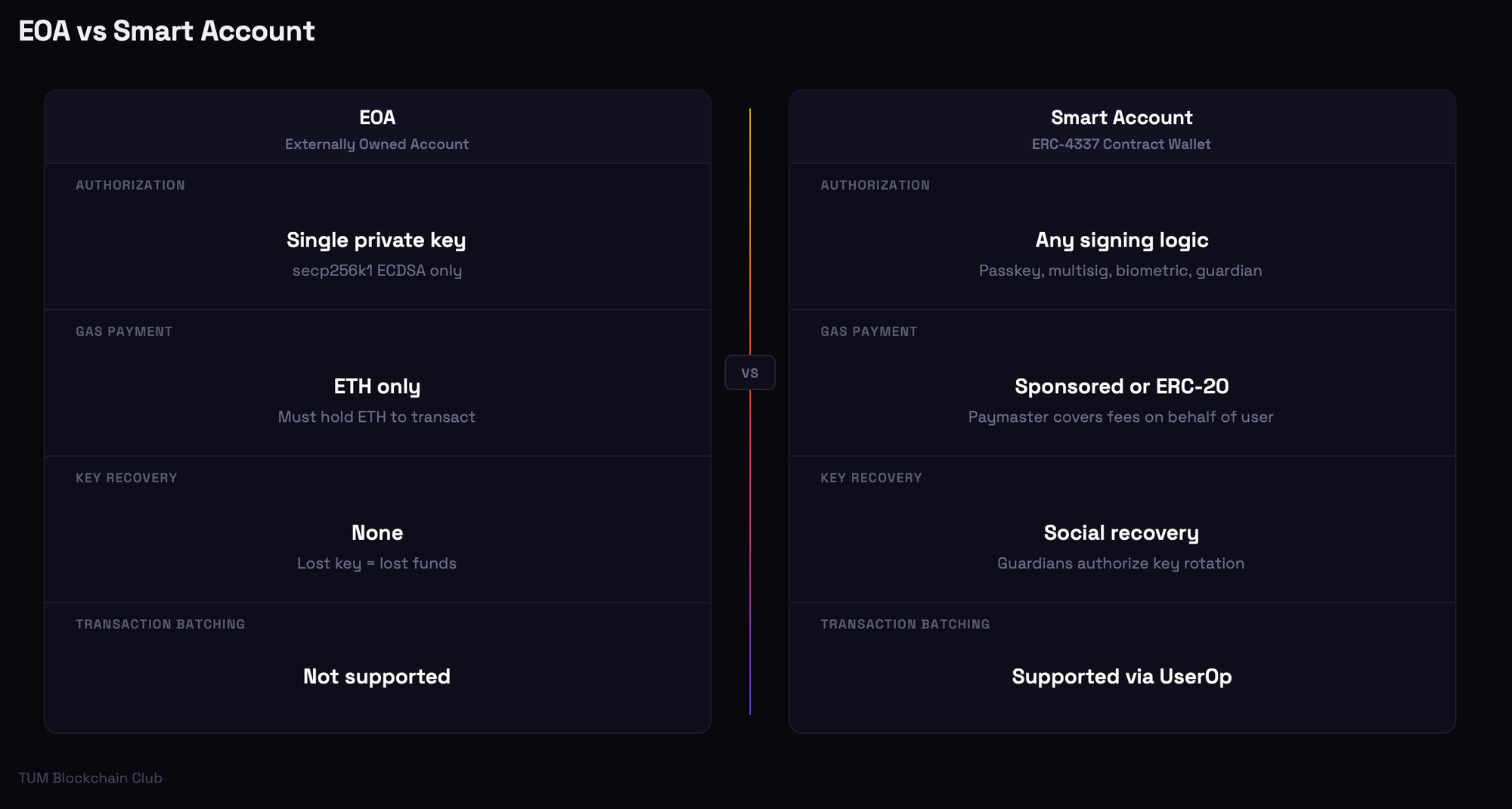
Ethereum has two account types. An externally owned account (EOA) is controlled by a private key and can initiate transactions directly. A contract account executes smart contract logic but cannot initiate transactions on its own.
An EOA comes into existence the moment a private key is generated. The process is done on your device through three mathematical steps:
| Step | Action |
|---|---|
| Private key | A cryptographically secure random number generator picks a random 256-bit number. |
| Public key | Your wallet takes that private key and derives a corresponding public key using elliptic curve multiplication on a specific curve called secp256k1. |
| Ethereum address | The wallet hashes the public key using Keccak-256 and takes the last 20 bytes of the result to form the Ethereum address. |
However, EOAs have one structural flaw: whoever controls the private key controls everything in the account. There is no recovery mechanism, spending limit, or a way to automatically block suspicious transactions.
This is not a criticism of Ethereum's early design choices. EOAs are sufficient for a system where the primary users are technically sophisticated. But as Ethereum expands to general users, the single-key model has become a barrier. Account abstraction eliminates this vulnerability at its core.
What Account Abstraction Actually Unlocks
Social recovery replaces the seed phrase with a guardian model. Instead of a single private key being the sole path to the account, the smart account designates a set of guardians: trusted contacts, other wallets, or a hardware device. If the primary signing key is lost, the guardians can collectively authorize a key rotation, which links your account to a new private key.
Session keys solve the problem of repeated wallet confirmations for every in-app action. In traditional blockchain architecture, every on-chain interaction requires an individual wallet confirmation, disrupting the user experience. Account abstraction resolves this friction through session keys. A session key is a temporary cryptographic key with limited permissions. A wallet can restrict it to a specific application, a spending limit, and a fixed expiration time.
Gas abstraction removes the requirement to hold ETH to pay fees. A paymaster can sponsor transactions entirely or accept an ERC-20 token instead. A new user who does not own ETH and does not know what gas is can still complete their first transaction because the application pays for it invisibly. For consumer onboarding this removes one of the biggest barriers to entry in the industry.
Account abstraction changes crypto wallets from fixed protocol objects into programmable user accounts. This allows wallet UX to evolve similarly to modern web applications, where authentication, recovery, permissions, and payments are all flexible software design choices rather than protocol constraints.
The Introduction of ERC-4337 and How It Works
Ethereum's implementation of an account abstraction model called ERC-4337 was introduced in March 2023. Under this model, users can operate through smart contract accounts whose authorization rules are fully programmable, which means they can be as simple or as sophisticated as the developer wants.
The UserOperation
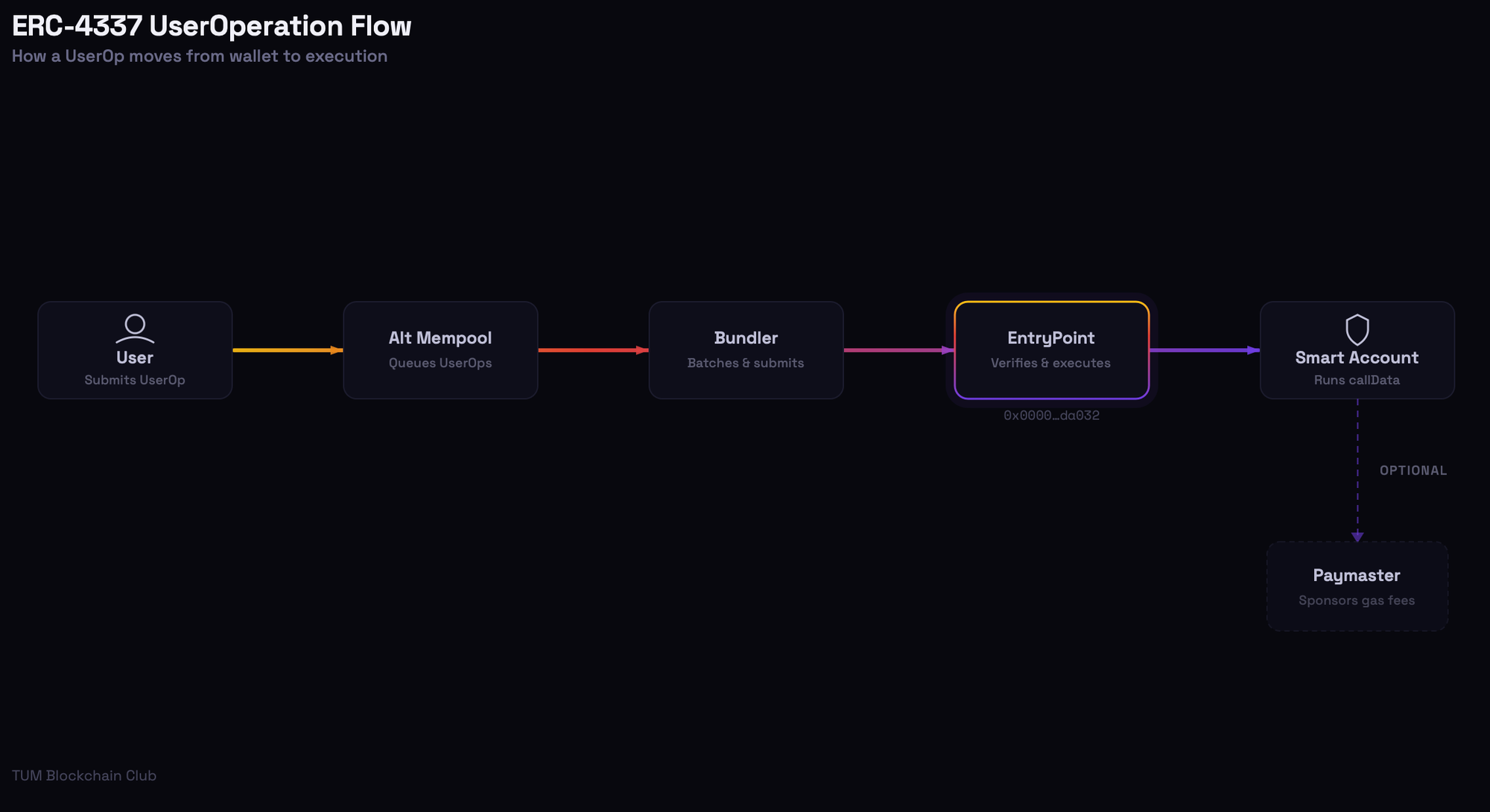
The ERC-4337 standard introduces a new transaction type called a UserOperation (UserOp). Instead of sending a regular transaction to the blockchain, a user submits a UserOp to a separate mempool with the user's intended action and custom conditions.
A simplified version of the structure looks like this:
struct UserOperation {
    address sender;
    uint256 nonce;
    bytes   initCode;
    bytes   callData;
    uint256 callGasLimit;
    uint256 verificationGasLimit;
    uint256 preVerificationGas;
    uint256 maxFeePerGas;
    uint256 maxPriorityFeePerGas;
    bytes   paymasterAndData;
    bytes   signature;
}
Each field plays a specific role in how the operation is formed and validated:
| Field | Role |
|---|---|
sender | The address of the smart account submitting the operation. |
nonce | Prevents replay attacks, like in a standard Ethereum transaction. |
callData | Contains the encoded function call and execution parameters. |
initCode | Only applies to a user's first transaction. If the smart account has not yet been deployed on-chain, this field contains the bytecode needed to create it. The EntryPoint deploys the contract and executes the operation within the same transaction flow. |
verificationGasLimit | The maximum gas allocated for the account's validation and authorization phase. |
callGasLimit | The maximum gas allocated for executing the main smart contract call. |
preVerificationGas | The gas allocated to cover the bundler's overhead costs before execution begins. |
maxFeePerGas / maxPriorityFeePerGas | The maximum total fee and priority fee per unit of gas, following standard EIP-1559 pricing. |
paymasterAndData | Empty when the smart account is responsible for covering gas fees. When a third party covers it, this field holds the paymaster's address and its signed approval. |
signature | Validated by the smart account's own logic, not the protocol. The account can accept any validation method: a passkey, a multisig threshold, a biometric, or a time-locked guardian approval. |
Bundlers and the Alt Mempool
Specialized nodes called bundlers collect UserOps and batch them together. They then submit the batch as a single transaction to a global contract called the EntryPoint, which verifies and executes each operation in sequence. Bundlers earn the aggregated gas fees from the operations they include. They are economically incentivized to include valid UserOps and exclude ones that would fail, because a failed operation wastes their gas without reimbursement.
The EntryPoint Contract
The bundler submits its batch transaction to a singleton contract called the EntryPoint, deployed at 0x0000000071727De22E5E9d8BAf0edAc6f37da032 on Ethereum and other supported EVM-compatible chains. Because it operates as a single instance per chain, it is shared by all smart accounts and bundlers, which eliminates fragmentation across different wallet implementations. When a batch arrives, the EntryPoint loops through each UserOp. For each operation, it calls the sender's smart account to run its verification logic, and if verification passes, the EntryPoint executes the callData function. Verification and execution are two separate calls, which is what makes gas sponsorship possible: a third party can agree to pay for the execution step without being involved in the authorization logic.
This shared design is what allows different wallet systems to work together. Any smart account interfaces with this exact same EntryPoint. Safe, the most widely deployed multisig infrastructure in the ecosystem, achieved native account abstraction compatibility through a modular plug-in rather than a core rewrite. Because Safe accounts now flow through the same EntryPoint as any other, it proves the standard is working as intended: a single, immutable coordination point supporting infinite implementations.
Paymasters: Who Pays the Gas?
A paymaster is an optional contract that can cover the gas cost of a UserOp, subject to its own conditions. The paymaster's address and its signed approval go in the paymasterAndData field. The EntryPoint checks the paymaster's balance before execution and ensures the fees will be covered.
Two patterns are common. In the first, a dApp sponsors the fees entirely: the user submits a UserOp, the dApp's paymaster pays the gas, completely removing ETH gas fees from the user experience. In the second, a paymaster accepts an ERC-20 token from the user instead of ETH, converting it to cover the gas cost. The user pays using a supported token, while the paymaster handles the conversion.
The Unsolved Problems of Account Abstraction
Account abstraction does not eliminate complexity but rather moves it.
Social recovery shifts single-key risk to guardian selection risk. Guardians must be accessible enough to perform a recovery, but not so accessible that a malicious actor can compromise enough of them to take over the account. This is a new skill most users have not developed, and wallet interfaces have not yet made the tradeoff easy to understand.
Bundler decentralization is an open problem. Most UserOp volume today flows through a small number of operators. The architecture is designed to be permissionless, but the ecosystem has not yet been distributed in practice to match that design. If those operators coordinate to censor certain accounts, the censorship resistance of ERC-4337 is compromised in practice.
The longer-term question is what EIP-7702 means for the standard. Pectra, which activated on the Ethereum mainnet on May 7, 2025, included EIP-7702, which lets an EOA temporarily delegate its behavior to a smart contract for a single transaction, without migrating to a new address or deploying a new contract. If wallets widely adopt this model, mainstream users could benefit from gas sponsorship and transaction batching directly through their existing EOAs, eliminating the need to migrate to a full smart account. Meanwhile, ERC-4337's deeper capabilities, such as persistent session keys, guardian sets, and custom signature schemes, would remain the blueprint for more sophisticated applications. Whether this leads to a division of labor or a gradual takeover is the central question the industry is trying to address.
FAQ
What is the difference between account abstraction and a regular Ethereum wallet?
A regular Ethereum wallet is an externally owned account (EOA), controlled by a single private key. Account abstraction replaces that model with a programmable smart contract wallet, where the authorization rules, recovery options, and gas payment logic are all defined by the wallet's own code rather than enforced uniformly by the protocol.
Do I need to hold ETH to use an ERC-4337 wallet?
Not necessarily. A paymaster can sponsor your gas fees entirely, or accept an ERC-20 token in place of ETH. Whether this is available depends on the application you are using and whether it has configured a paymaster for its users.
What is EIP-7702 and how does it relate to account abstraction?
EIP-7702, activated as part of the Pectra upgrade in May 2025, lets a standard EOA temporarily behave like a smart contract for a single transaction. It gives existing wallets access to some account abstraction features without a full migration. ERC-4337 remains the standard for wallets that need persistent programmability to support features like guardian sets, session keys, and custom signature schemes.