Stablecoin Regulations in the EU: How MiCA Works
In May 2022, TerraUSD lost its dollar peg in four days, erasing over $50 billion in market capitalization, and left holders with no legal right to redeem their tokens at face value, because no such right existed.
Stablecoin regulations have become one of the most significant developments in cryptocurrency policy as governments seek to address the risks associated with privately issued digital assets. For years, stablecoins operated in a regulatory grey area across the European Union, where issuers could serve users across multiple member states without complying with a single, standardized framework governing reserves, redemption rights, disclosures, or supervision.
Why Stablecoin Regulations Exist
Before MiCA, the EU, having 27 member states, had 27 different national approaches to crypto-asset regulation. A stablecoin issuer could operate across the entire European market without holding a license in any jurisdiction. There was no regulatory framework governing how tokens were backed, how reserves were managed, or whether holders had a right to redemption. 1
TerraUSD illustrated what this gap looked like in practice. UST maintained its dollar peg through an algorithm that relied on its companion token, LUNA, to absorb volatility. When the system lost market confidence in May 2022, the mechanism collapsed, and holders had no legal right to redeem their tokens at face value. In May 2022, the value of LUNA fell from over $120 to effectively zero within days. UST/LUNA together lost over $50 billion in market capitalization, and the broader cryptocurrency markets saw over $400 billion in losses.2
Asset-backed stablecoins operating in Europe at the time, including the largest ones by volume, were under no regulatory obligation to disclose their reserve holdings, maintain separate accounts, or undergo external audits. Following several high-profile failures, policymakers increasingly focused on whether stablecoins required a harmonized regulatory framework.1
What is MiCA?
The Markets in Crypto-Assets Regulation (MiCA) is a single EU-wide legal framework that entered into force in June 2023 and covers the issuance of crypto-assets, the operation of stablecoin issuers, and the authorization of crypto-asset service providers.3 Stablecoin-specific rules, covering what MiCA calls asset-referenced tokens and e-money tokens, became applicable on June 30, 2024. The authorization requirements for crypto-asset service providers came into effect on December 30, 2024.4
The regulation creates a unified authorization system across all 27 EU member states. A company that receives a license in its home country can offer its services across the entire EU without needing separate approvals in each jurisdiction.3
Three supervisory bodies share responsibility for enforcement:
- The European Banking Authority (EBA) supervises stablecoin issuers, particularly those issuing high-volume tokens.5
- The European Securities and Markets Authority (ESMA) monitors crypto-asset service providers and coordinates the consistent application of the rules across national regulators. 6
- National Competent Authorities (NCAs) handle licensing and day-to-day supervision within their specific jurisdictions.3
ARTs and EMTs
A stablecoin is a crypto-asset designed to maintain a stable value by referencing one or more external assets, typically a fiat currency. Instead of using 'stablecoin' as a legal term, MiCA establishes two distinct categories based on the underlying reference asset and regulates each differently.3
An e-money token (EMT) references a single official fiat currency and functions as a digital representation of that currency.7 EURC, issued by Circle, is an EMT pegged 1:1 to the euro. USDC, also issued by Circle, is an EMT pegged to the US dollar.8 Under MiCA, EMTs can only be issued by entities already authorized as either a credit institution or an electronic money institution (EMI) under existing EU financial services law. MiCA layers additional stablecoin-specific obligations on top of the existing authorization rather than creating a separate licensing track.3
An asset-referenced token (ART) is a type of crypto-asset that derives its value from one or more underlying assets, such as multiple currencies, commodities, crypto-assets, or a combination of these. For example, a token pegged to both the euro and the US dollar, or one backed by gold, would be considered an ART.
Issuers of ARTs must be legally established in the EU and obtain authorization from their national competent authority. However, they do not need an electronic money institution (EMI) or banking license. Instead, ARTs follow a separate authorization process under Title III of the Markets in Crypto-Assets Regulation (MiCA).3
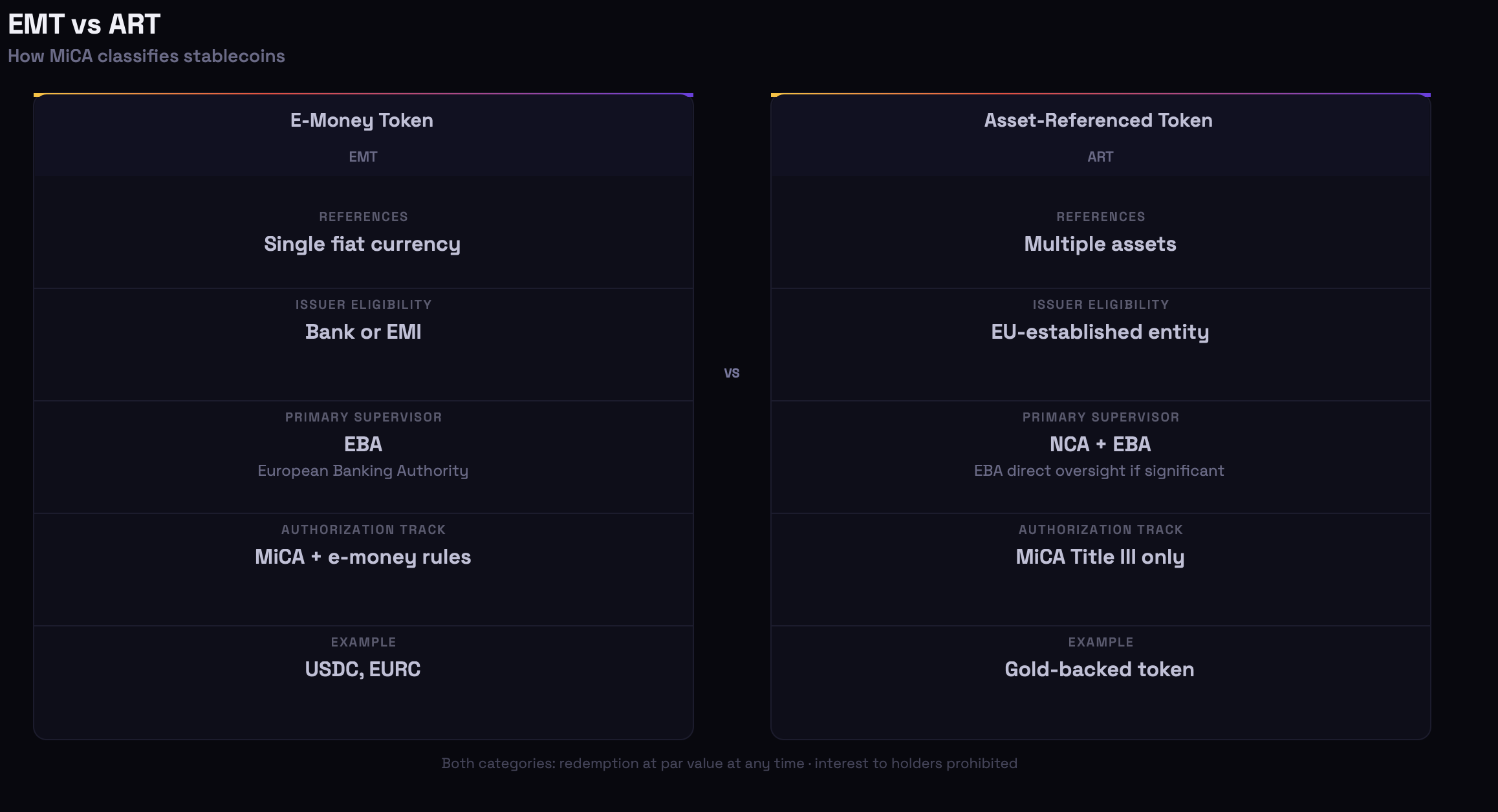
The main difference between those categories is that EMTs fall within the EU's existing electronic-money framework, while ARTs follow a separate authorization regime under MiCA.3
What the Rules Require: Reserves, Redemption, and Disclosure
At the core of MiCA’s stablecoin framework are requirements that set out how tokens must be backed, how holders can redeem them, and what information issuers must disclose publicly.
- Reserve Requirements: Every token must be backed 1:1 by reserve assets that are fully separate from the issuer's own funds.9 For non-significant tokens, at least 30% of these reserves must be held in bank accounts spread across multiple institutions; for significant tokens, it's 60%.10 The remainder must be invested in secure, highly liquid financial instruments with low market and credit risk.9
- Redemption Rights: Token holders have an unconditional, legally enforceable right under EU law to redeem their tokens at par value at any time, denominated in the referenced fiat currency.3
- No-Interest Rule: Issuers are strictly prohibited from paying interest or yield to token holders. This draws a regulatory line between a stablecoin and a bank deposit, effectively banning yield-bearing stablecoin models within the EU.3
- White Paper Disclosure: At least 20 working days before a public offering, issuers must publish a detailed white paper and notify their national competent authority.11 For asset-referenced tokens (ARTs), the white paper must be approved by the national competent authority before it is published. For e-money tokens (EMTs), the issuer only needs to notify the authority; prior approval is not required, although the authority can still request changes.12
- Significant Token Classification: Stablecoins exceeding 10 million holders or €5 billion in value are classified as "significant" and fall under direct EBA supervision.5 These tokens face stricter rules, including higher capital requirements (up to 3% of reserves) and mandatory recovery plans.13
| Requirement | Standard issuer | Significant issuer |
|---|---|---|
| Reserve backing | Fully backed 1:1, with reserves held separately | Fully backed 1:1, with reserves held separately |
| Bank account requirement | At least 30% of reserves held in bank accounts | At least 60% of reserves held in bank accounts |
| Own funds requirement | Minimum of 2% of average reserves | Up to 3% of average reserves |
| EBA supervision | Not directly supervised by EBA | Direct supervision by EBA |
| Recovery planning | Not required | Required |
Circle and Tether: Compliance in Practice
The practical impact of MiCA's stablecoin framework is clearly illustrated by the opposing strategies of Europe's two dominant issuers, Circle and Tether.
In July 2024, Circle obtained authorization as an electronic money institution in France, making USDC and EURC MiCA-compliant EMTs.8 Both tokens continued to be listed on EU-regulated exchanges and supported by licensed crypto-asset service providers across the market. Circle had to first get authorized under the EU's existing electronic money rules, and then, satisfy MiCA's strict stablecoin standards.
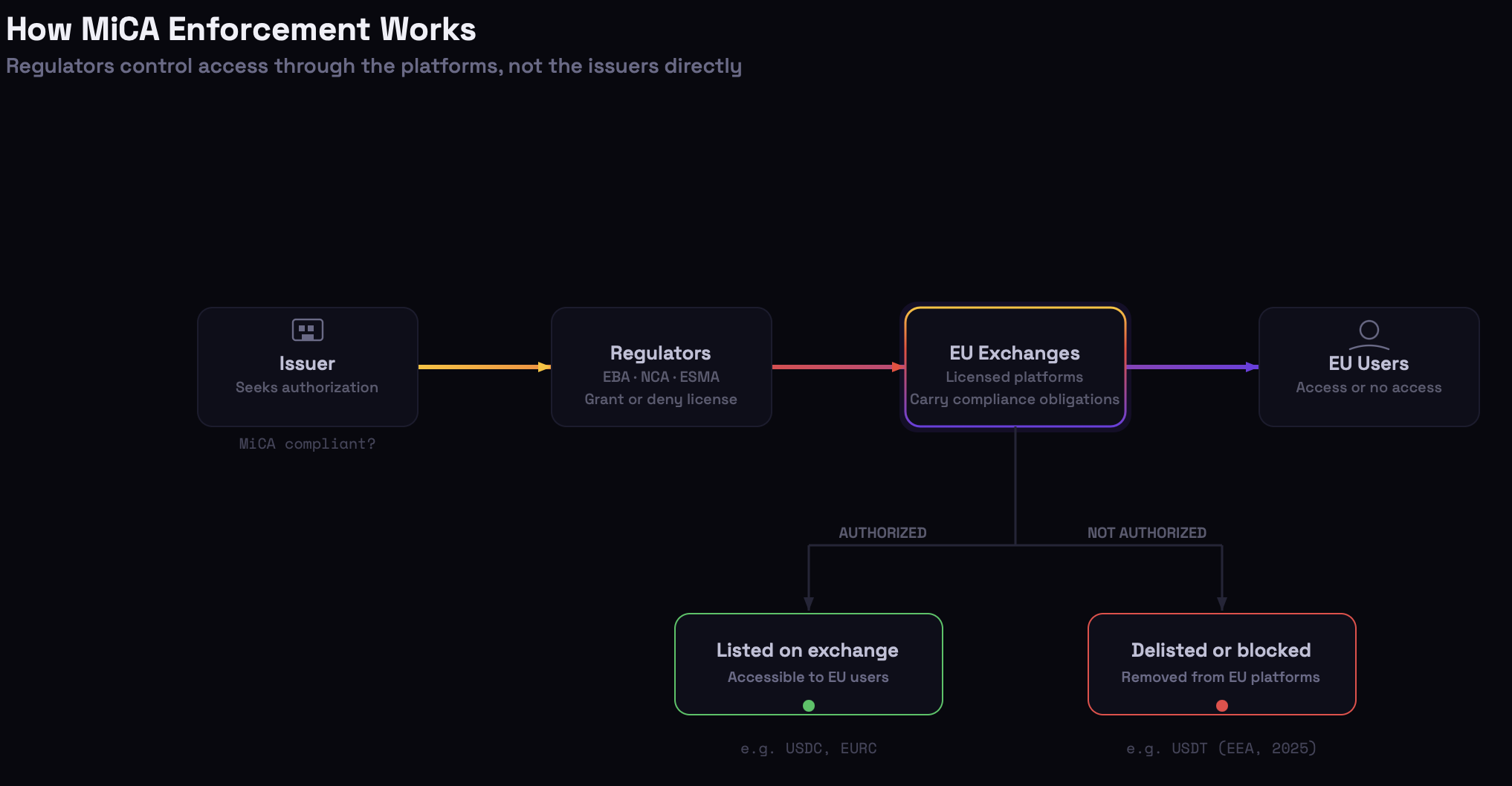
Tether chose not to seek MiCA authorization for USDT, the world's largest stablecoin.14 Because of how MiCA is structured, this choice led to immediate consequences: under Title V, licensed crypto platforms are restricted from offering non-MiCA-compliant stablecoins to European users.6 As a result, the removal of USDT from EU exchanges was not a voluntary business decision, but a compliance obligation.
This outcome shows how MiCA is enforced through the structure of the market. Regulators do not need to take direct action against a non-EU stablecoin issuer. They authorize the platforms, the platforms carry compliance obligations, and those obligations determine which tokens can be offered. A stablecoin that does not meet MiCA's requirements loses access to the EU's regulated market.
The July 1, 2026 Deadline
MiCA gave existing businesses time to adjust. Companies that were already providing crypto-asset services under national regimes before December 30, 2024, were allowed to continue operating during a transitional period while they sought MiCA authorization. EU member states could choose how long to extend that period, up to a maximum of 18 months.15
The Netherlands, Latvia, Hungary, and Slovenia ended their transitional periods by June 2025. Germany, Austria, and Ireland ran until December 2025. France, Malta, Luxembourg, and Cyprus, among others, extended the full 18 months, running until July 1, 2026.16
July 1, 2026 is the final deadline. After this date, the EU’s transitional arrangements will no longer apply. ESMA has stated that any firm providing crypto-asset services to EU clients without MiCA authorisation must cease those activities.
For stablecoin issuers, the consequence is direct: without full authorisation by that date, their tokens must be removed from EU-regulated trading platforms.
During the transition period, enforcement is set out in MiCA Title VII. National competent authorities can issue public warnings, order cessation of services, and impose administrative fines. These may reach up to 15% of annual turnover for legal entities, or at least twice the profits gained or losses avoided. ESMA has also warned that national authorities are expected to take action against firms operating without authorisation once the deadline passes.17
ESMA has further noted that supervisory approaches across Member States have not been fully consistent. This has created scope for regulatory arbitrage, with companies choosing jurisdictions based on enforcement intensity rather than geography. Addressing these inconsistencies is one of MiCA’s objectives, although differences in application remain visible in practice.6
Remaining Challenges
Decentralized Finance (DeFi) remains the most significant unresolved area of the regulation. While MiCA explicitly exempts platforms that are "fully decentralized," European regulators have not yet legally defined what that term means.19 In practice, any crypto protocol with a clear governance team, an identifiable entity, or a managed treasury will likely have to comply with MiCA, regardless of how decentralized it describes itself. ESMA has not yet issued a precise definition, and no formal guidance timeline has been confirmed as of mid-2026.19
Overlapping rules have created a double-licensing burden for e-money token (EMT) issuers. Under current rules, companies that provide custody for EMTs must hold both a MiCA authorization and a traditional payment services license under the EU's Payment Services Directive (PSD2).20 This duplication forces companies to run parallel compliance operations, driving up expenses. Industry groups warn that this extra cost puts Euro-denominated stablecoins at a distinct competitive disadvantage.20
This strict approach also clashes with international regulatory trends, particularly regarding yield. The US GENIUS Act, signed on July 18, 2025, does not ban stablecoins from paying interest to users.21 This creates a clear regulatory divide, allowing yield-bearing stablecoins to thrive in the United States while remaining prohibited in the EU. If these yield-generating models attract significant global user bases, European lawmakers will face growing pressure over whether MiCA's absolute interest ban protects consumers or drives financial activity outside Europe.
MiCA addresses the risks highlighted by failures such as TerraUSD, introducing clear requirements for reserve backing, redemption rights, and issuer oversight. However, the framework's long-term success is still being tested by more challenging questions surrounding decentralized protocols, interest-bearing models, and whether a framework drafted years ago can keep up with shifting market realities.
What is the difference between an EMT and an ART under MiCA?
An e-money token references a single fiat currency and can only be issued by a bank or licensed electronic money institution. An asset-referenced token derives its value from a basket of assets, such as multiple currencies or commodities, and follows a separate authorization track under MiCA that does not require an EMI license. The key practical difference is that EMT issuers must already hold an existing EU financial services license before MiCA obligations even apply.
Can stablecoins pay interest or yield to holders in the EU?
No. MiCA strictly prohibits stablecoin issuers from paying any form of interest or yield to token holders, regardless of whether the token is an EMT or an ART. The rule draws a deliberate regulatory line between a stablecoin and a bank deposit: a stablecoin is designed to be a payment instrument, not an investment product. Any yield-bearing stablecoin model is effectively banned within the EU under the current framework.
What happens if a MiCA-authorized stablecoin issuer violates the rules?
National competent authorities can issue public warnings, order the cessation of services, and impose administrative fines. For legal entities, fines can reach up to 15% of annual turnover, or at least twice the profits gained or losses avoided through the violation. For stablecoin issuers classified as significant, the EBA takes over direct supervision and can apply additional measures, including requiring the issuer to activate its mandatory recovery plan.
Sources
- White & Case, MiCA Regulation: New regulatory framework for Crypto-Assets Issuers and Crypto-Asset Services Providers in the EEA, https://www.whitecase.com/insight-alert/mica-regulation-new-regulatory-framework-crypto-assets-issuers-and-crypto-asset
- Corporate Finance Institute, Terra — What it Was, Collapse, Stablecoin, https://corporatefinanceinstitute.com/resources/cryptocurrency/what-happened-to-terra/
- Regulation (EU) 2023/1114 of the European Parliament and of the Council of 31 May 2023 on markets in crypto-assets (MiCA), https://eur-lex.europa.eu/legal-content/EN/TXT/?uri=CELEX%3A32023R1114
- ESMA, Markets in Crypto-Assets Regulation (MiCA), https://www.esma.europa.eu/esmas-activities/digital-finance-and-innovation/markets-crypto-assets-regulation-mica
- EBA, Asset-referenced and e-money tokens (MiCA), https://www.eba.europa.eu/regulation-and-policy/asset-referenced-and-e-money-tokens-mica
- ESMA, Statement on the provision of certain cryptoasset services in relation to non-MiCA compliant ARTs and EMTs, December 2024, https://www.esma.europa.eu/sites/default/files/2025-12/ESMA75-113276571-1631_Statement_on_end_of_MiCA_transitional_periods.pdf
- MiCA Article 3(1)(7): definition of e-money token. Regulation (EU) 2023/1114.
- Circle, Circle Is First Global Stablecoin Issuer to Comply with MiCA, press release, July 1, 2024, https://www.circle.com/pressroom/circle-is-first-global-stablecoin-issuer-to-comply-with-mica-eus-landmark-crypto-law
- MiCA Article 54 (EMTs) and Article 36 (ARTs): reserve asset requirements. Regulation (EU) 2023/1114. See also White & Case (note 1).
- EBA, Final Report: Draft Regulatory Technical Standards on Liquidity Requirements of the Reserve of Assets(EBA/RTS/2024/10), June 2024, https://www.eba.europa.eu/sites/default/files/2024-06/580db2f3-8370-4927-baa3-0f995722b417/Final%20report_draft%20RTS%20further%20specifying%20the%20liquidity%20requirements%20Article%2036%204.pdf
- MiCA Article 51(11) (EMTs) and Article 17(1) (ARTs): white paper notification and approval requirements. Regulation (EU) 2023/1114.
- LegalBison, MiCA White Paper Rules: Can You Publish Before Approval?, https://legalbison.com/blog/mica-white-paper-approval-rules/; Paul Hastings, MiCA Crypto White Papers — Comply or Be De-Listed, https://www.paulhastings.com/insights/client-alerts/mica-crypto-white-papers-comply-or-be-de-listed
- EBA, EBA provides new rules for stablecoins (Ashurst summary of EBA RTS), https://www.ashurst.com/en/insights/eba-provides-new-rules-for-stablecoins/
- Coinbase delisting of USDT for EEA users effective December 13, 2024: Decrypt, Coinbase Europe Delists USDT, Other Stablecoins Citing EU Compliance, December 13, 2024, https://decrypt.co/296453/coinbase-europe-delists-usdt; Bloomberg, Coinbase to Delist Non-Compliant Stablecoins in EU in December, October 4, 2024, https://www.bloomberg.com/news/articles/2024-10-04/coinbase-to-delist-non-compliant-stablecoins-in-eu-in-december. Binance delisting of nine non-MiCA-compliant stablecoins including USDT for EEA spot trading effective March 31, 2025: Finance Magnates, Binance Finally Delists Tether USDT from European Spot Trading in Compliance with MiCA, April 2025, https://www.financemagnates.com/cryptocurrency/binance-finally-delists-tether-usdt-from-european-spot-trading-in-compliance-with-mica/
- MiCA Article 143(3): transitional provisions for existing CASPs. Regulation (EU) 2023/1114.
- ESMA, List of MiCA grandfathering periods — Article 143(3), https://www.esma.europa.eu/sites/default/files/2024-12/List_of_MiCA_grandfathering_periods_art._143_3.pdf; Aosphere, Member State Implementation of MiCA — Updated Tracker, https://www.aosphere.com/know-how/member-state-implementation-of-mica-updated-tracker/
- ESMA, Statement on MiCA transitional periods, December 17, 2024 (ESMA75-113276571-1631); ESMA supervisory statement, April 2026 (ESMA75-113276571-1679).
- MiCA Title VII (Articles 94–111): administrative penalties and measures. Regulation (EU) 2023/1114. For a concise summary of the penalty ranges see CMS, Overview of the Competent Authorities under MiCAR, https://cms.law/en/int/publication/legal-experts-on-markets-in-crypto-assets-mica-regulation/overview-of-the-competent-authorities-under-micar
- EBA and ESMA, Joint Report on Decentralised Finance (DeFi) (factsheet), 2025, https://www.eba.europa.eu/regulation-and-policy/asset-referenced-and-e-money-tokens-mica
- EBA, Opinion on supervisory priorities at the end of the transition period under the EBA's No Action Letter on the interplay between PSD2 and MiCA, February 2026, https://www.eba.europa.eu/regulation-and-policy/asset-referenced-and-e-money-tokens-mica; Hogan Lovells, The EU's Markets in Crypto-Assets MiCA Regulation — a status update, https://www.hoganlovells.com/en/publications/the-eus-markets-in-crypto-assets-mica-regulation-a-status-update
- The White House, Fact Sheet: President Donald J. Trump Signs GENIUS Act into Law, July 18, 2025, https://www.whitehouse.gov/fact-sheets/2025/07/fact-sheet-president-donald-j-trump-signs-genius-act-into-law/